What makes the most sense to me is the description of photos for the first-order messiness example in chapter 9. I too have my fair share of pictures stuffed in shoe boxes and drawers. I bought photo albums for my high school graduation party and attempted to fill some of them to put on display, but you can’t possibly put all of your pictures in photo albums because some just aren’t worthy enough, and nobody really wants to have thirty photo albums sitting around (although that reminds me of an episode of “Girls Next Door” where Hugh Hefner has a library of scrap books—nearly 2,000 of them spanning his lifetime).
I never thought of how the value of the pile of pictures goes down the more you add to it. Weinberger says “the more photos you add, the less likely you’re going to be able to find a particular photo, and the bigger the hurdle to making the pile usable” (175). Here's a commercial I recently saw that perfectly describes this.
Sometimes I have a hard time finding my digital photos on my computer too, although it's not as bad as the photos in the shoeboxes. I have hundreds of pictures that I have at least tried to organize by folders on my computer, but it’s still messy. Weinberger says that the more information, or metadata, is attached to each photo, the more potential it has regardless of how messy it may be. This is apparent in the example that is given with Flickr, where we can acknowledge that messiness is okay as long as you can find whatever it is you’re looking for, which makes me think about my house. Although my house is clean, it tends to be on the messy side--clothes may be all over the place, books lying around, etc. (not complaining, we've just always been a very busy family). If my Dad tries to “clean” things up though, my Mom gets angry because she can never find anything afterwards. Even though it is “messy,” my Mom still knows where everything is. And if my Dad puts things where they don’t “belong” then you could be stuck searching for that one shoe you left in the living room for months, like that one photo you just can’t seem to find in your overflowing shoe box of memories.
Tuesday, April 28, 2009

Tuesday, April 21, 2009
Oakland, The World, and the Divide: How We All Missed the Moment
I don’t know much about the issues of access regarding technology or the statistics other than the fact that some people are always at an advantage and others are always at a disadvantage. Coming from an all white, middle class school district, I can’t pretend to speak for African Americans and their struggles with the “Digital Divide.” However, I would like to argue that I believe it’s more than just a race issue, and that issues of class must also be recognized. Although Banks seemed to be primarily concerned with the race issue, he did mention how computers are distributed differently among races and socioeconomic status, which “contributes to the ongoing patterns of racism and the continuation of poverty.”
I’m not saying I’m naive about the fact that African Americans may not have equal access to technology. I just don’t feel comfortable discussing the issue without being completely informed about it, which is why I’d like to pay more attention to equal access for everybody. This was a topic that came up in my Composition of Theory course. We discussed how integrating computers into the classroom will set particular students apart from others and put them at a disadvantage. Since the language of computers is English, all other languages and their cultures are automatically seen as second-class status (Moran 215). Right away that contributes to alienating different races and/or cultures, “especially among families in poverty and families of color” (DeVoss 170). Now obviously it would be ideal for every school to have computers and teachers who were trained to teach with them, but I don’t think computers in schools is enough. Students who own computers are at an advantage over students who do not own them. When it comes to the issue of class, not all families can afford computers, so students from low-income families will not have the same privileges as students who do have a computer in their home.
Here are the two articles I cited from:
DeVoss, Danielle Nicole, et al. "Under the Radar of Composition Programs: Glimpsing the Future Through Case Studies of Literacy in Electronic Contexts." Composition Studies in the New Millennium: Rereading the Past, Rewriting the Future. Ed. Lynn Z Bloom, Donald A Daiker, and Edward M White. Carbondale: Southern Illinois UP, 2003. 157-173.
Moran, Charles. "Technology and the Teaching of Writing." A Guide to Composition Pedagogies. Ed. Gary Tate, Amy Rupiper, and Kurt Schick. New York: Oxford UP, 2001. 203-223.
I’m not saying I’m naive about the fact that African Americans may not have equal access to technology. I just don’t feel comfortable discussing the issue without being completely informed about it, which is why I’d like to pay more attention to equal access for everybody. This was a topic that came up in my Composition of Theory course. We discussed how integrating computers into the classroom will set particular students apart from others and put them at a disadvantage. Since the language of computers is English, all other languages and their cultures are automatically seen as second-class status (Moran 215). Right away that contributes to alienating different races and/or cultures, “especially among families in poverty and families of color” (DeVoss 170). Now obviously it would be ideal for every school to have computers and teachers who were trained to teach with them, but I don’t think computers in schools is enough. Students who own computers are at an advantage over students who do not own them. When it comes to the issue of class, not all families can afford computers, so students from low-income families will not have the same privileges as students who do have a computer in their home.
Here are the two articles I cited from:
DeVoss, Danielle Nicole, et al. "Under the Radar of Composition Programs: Glimpsing the Future Through Case Studies of Literacy in Electronic Contexts." Composition Studies in the New Millennium: Rereading the Past, Rewriting the Future. Ed. Lynn Z Bloom, Donald A Daiker, and Edward M White. Carbondale: Southern Illinois UP, 2003. 157-173.
Moran, Charles. "Technology and the Teaching of Writing." A Guide to Composition Pedagogies. Ed. Gary Tate, Amy Rupiper, and Kurt Schick. New York: Oxford UP, 2001. 203-223.
Tuesday, April 14, 2009
Everything is Miscellaneous Ch. 7-8
I like the idea that knowledge is becoming more of a social act. I also like knowing that I can be regarded as an individual rather than the whole when it comes to my interests. I like miscellaneousness over men in a board room making decisions for me. Weinberger says, “Authorities have long filtered and organized information for us, protecting us from what isn’t worth our time and helping us find what we need to give our beliefs a sturdy foundation” (132). But what do these so-called authorities know about me? How do they know what I want filtered or what things I want to know? How can they possibly filter and organize information in a way that works for every single individual? Maybe it’s “comforting” knowing that somebody has taken the time to filter things that are useless, but maybe it’s also made us more skeptical. I certainly don’t believe everything I see or hear anymore. I have turned into somebody that questions everything. Is it because of something like wikipedia that has made me this way?
I don’t use wikipedia for any type of academic work, unless I am looking for the basic knowledge of an unknown “something” and just need a quick answer. But I never use wikipedia for more “important” things like research, because everyone knows that you can’t count on it being a credible source since you don’t know who the information is coming from. But in a way, I also think it’s reassuring that wikipedia posts notices like “the neutrality and factual accuracy of this article are disputed” (see page 140 for more). It allows me to go through the page with some ease, knowing that I don’t have to question whether it’s credible or not, because they’ve already come out and stated that it may not be.
This made me think of the in-class group assignment we did the other day. One group used the freevibe.com website, and it was pointed out that the information on the page wasn’t all factual, and we wondered where it was even coming from. We also noticed the “staging” of the pictures that were used, and the fact that the testimonials were clearly hand chosen (because a website against using drugs isn’t going to post anything that goes against their stance, like a post that says, “Drugs are fine. I’ve been using them for years and blah blah blah…you get my point”). And this goes back to the reading where Weinberger points out how newspaper stories are usually “presented as nothing less than rock solid,” and “letters to the editor [are] carefully selected by the editors” (141). What can we trust anymore? Who can we trust anymore? What are the proper ethics, and who has the authority to choose what and how much of something should be included?
On another note, I also liked the section on how social knowing changes who does the knowing and how. The description of students doing their homework while they have multiple instant messages going on, comparing answers, and asking for help on questions was pretty much describing me in high school (and from what I’ve seen on other students laptops in some of my classes, describes some students still today). But whereas standardized testing valued individual knowledge, this other type values social learning. I believe both are important, but clearly the latter is becoming more and more useful and relevant today. I’m a big fan of collaboration, or what Weinberger refers to as conversation. And if I like this type of learning, I suppose I like the idea of wikipedia and how it allows group knowledge to evolve (though there are still concerns obviously). But at least in this case, “what you learn isn’t prefiltered and approved, sitting on a shelf, waiting to be consumed” (146), although that type of learning still has value too.
I don’t use wikipedia for any type of academic work, unless I am looking for the basic knowledge of an unknown “something” and just need a quick answer. But I never use wikipedia for more “important” things like research, because everyone knows that you can’t count on it being a credible source since you don’t know who the information is coming from. But in a way, I also think it’s reassuring that wikipedia posts notices like “the neutrality and factual accuracy of this article are disputed” (see page 140 for more). It allows me to go through the page with some ease, knowing that I don’t have to question whether it’s credible or not, because they’ve already come out and stated that it may not be.
This made me think of the in-class group assignment we did the other day. One group used the freevibe.com website, and it was pointed out that the information on the page wasn’t all factual, and we wondered where it was even coming from. We also noticed the “staging” of the pictures that were used, and the fact that the testimonials were clearly hand chosen (because a website against using drugs isn’t going to post anything that goes against their stance, like a post that says, “Drugs are fine. I’ve been using them for years and blah blah blah…you get my point”). And this goes back to the reading where Weinberger points out how newspaper stories are usually “presented as nothing less than rock solid,” and “letters to the editor [are] carefully selected by the editors” (141). What can we trust anymore? Who can we trust anymore? What are the proper ethics, and who has the authority to choose what and how much of something should be included?
On another note, I also liked the section on how social knowing changes who does the knowing and how. The description of students doing their homework while they have multiple instant messages going on, comparing answers, and asking for help on questions was pretty much describing me in high school (and from what I’ve seen on other students laptops in some of my classes, describes some students still today). But whereas standardized testing valued individual knowledge, this other type values social learning. I believe both are important, but clearly the latter is becoming more and more useful and relevant today. I’m a big fan of collaboration, or what Weinberger refers to as conversation. And if I like this type of learning, I suppose I like the idea of wikipedia and how it allows group knowledge to evolve (though there are still concerns obviously). But at least in this case, “what you learn isn’t prefiltered and approved, sitting on a shelf, waiting to be consumed” (146), although that type of learning still has value too.
Saturday, April 4, 2009
Understanding Comics (Ch. 6 Show and Tell)
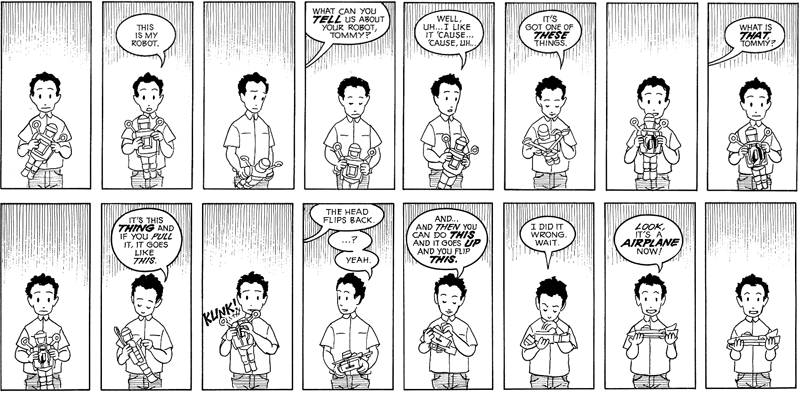
I found Scott McCloud’s chapter, “Show and Tell,” very interesting. I like that he started out with the young boy trying to describe his toy with words and not being able to really say what it was or how it worked. I’ve never been into reading comics, but I can appreciate their art of storytelling. Before reading this chapter, I assumed writing comics was simple. I didn’t realize that there are so many ways that words and pictures can work together. McCloud breaks up the different ways in to categories, which I find very helpful. I also liked his description of words and pictures acting like partners in a dance. He says, “Each one takes turns leading…when both partners try to lead, the competition can subvert the overall goals.”
To explain each category, I tried to find examples, or pictures, that would help illustrate my words. It was a lot harder finding an example of each than I thought it would be. Click on the pictures to make them larger.
1. Word specific: pictures illustrate but don’t significantly add to a largely complete text
I chose this comic because if you just looked at the pictures, you could come up with a different meaning than what you get from the text. After you read the text, though, the picture makes more sense.


To explain each category, I tried to find examples, or pictures, that would help illustrate my words. It was a lot harder finding an example of each than I thought it would be. Click on the pictures to make them larger.
1. Word specific: pictures illustrate but don’t significantly add to a largely
complete textI chose this comic because if you just looked at the pictures, you could come up with a different meaning than what you get from the text. After you read the text, though, the picture makes more sense.

This comic is all about the pictures. The words really are the "soundtrack" to the action taking place.

3. Duo-Specific: both words and pictures send essentially the same message
You could just look at the pictures and grasp the message (and vice versa).

4. Additive: words amplify or elaborate on an image or vice versa
In this comic, the words aren't even necessary. You can get the message by just looking at the picture. The words are extra.
5. Parallel: words and pictures seem to follow very different courses without intersec ting
ting
This was the hardest example for me to find. It may be a stretch. I chose it because the text and the pictures don't really make sense together. The text and the picture seem to be two different stories.

6. Montage: words are treated as integral parts of the picture
I couldn't find a comic example for this, but the picture works for the whole idea of words being used to make up the picture.
7. Interdependent: words and pictures go hand in hand to convey an idea that ne ither could convey alone
The text and the pictures work together nicely. In this case, the text says more than the picture, so the picture is allowed to be more free.
Subscribe to:
Posts (Atom)